When founders pay for commitment with “the future”
When a company doesn’t yet have strong cash flow but starts to need more operating capability, many founders unconsciously recruit with vision and a future that hasn’t arrived. The problem is that founders and employees are making very different bets.

This is a very common pattern in early-stage businesses. When a company doesn’t yet have strong cash flow but starts to need more operating capability, many founders unconsciously recruit with a kind of “substitute currency”: vision, ambition for growth, and a future they themselves believe will come.
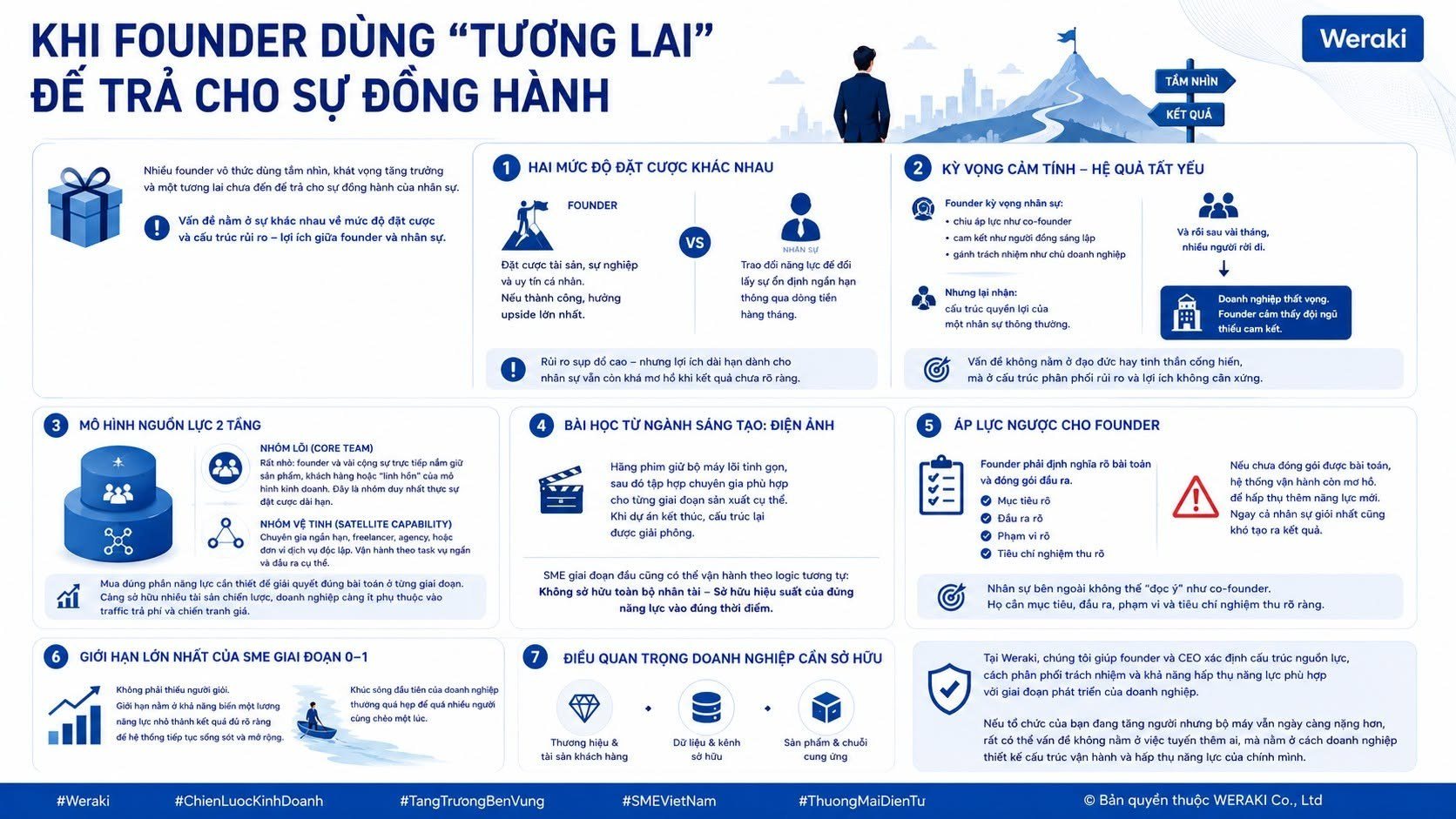
Two different levels of stake
The problem is that founders and employees usually enter the business with completely different levels of stake.
As a founder, you stake your assets, career and personal reputation on the business. If it succeeds, you also capture the largest upside. That is the natural logic of ownership.
For most employees, though, the relationship with the business follows a different logic: trading capability for short-term stability through a monthly paycheck. While the company has no clear results yet, the risk of collapse is still high, but their share of the long-term benefit is often vague.
Emotional expectations and their consequences
That is when many founders slip into a very emotional kind of expectation, often without noticing. We expect employees to:
- take pressure like a co-founder,
- commit like a co-founder,
- carry responsibility like an owner,
while receiving the benefits structure of an ordinary employee. A few months later, many of them leave.
The business is disappointed. The founder feels the team lacks commitment. But in many cases the problem isn’t work ethic or dedication. It is that the distribution of risk and reward was unbalanced from the start.
We have every right to bet on our own future. But it is hard to ask others to bet the same way when the system hasn’t yet built enough pull and the long-term reward is still unclear.
This is also why many SMEs at the 0–1 stage hit a common paradox: the more people they hire, the heavier the organization becomes. Not because the people are weak, but because the business is trying to own a resource structure beyond what the system can actually absorb.
A two-tier resource model
At this stage, what a business needs is sometimes not to own all its talent full-time, but to access the right capability at the right time. From observing many SMEs, we find the early stage often suits a two-tier resource structure:
- Core team
- A very small group: the founder and a few partners who directly hold the product, the customers or the “soul” of the business model. This is the only group truly betting long-term on the company’s future.
- Satellite capability
- Short-term experts, freelancers, agencies or independent service providers. This group works on short assignments with specific outputs.
Instead of maintaining a structure larger than current cash flow allows, the business buys only the capability needed to solve the right problem at each stage.
A lesson from film
Many creative industries have worked this way for a long time. Film is a classic example. A studio doesn’t keep thousands of full-time staff waiting for the next project. It keeps a very lean core, then assembles the right specialists for each stage of production. When the project ends, the structure is released.
In many respects, early-stage SMEs can work the same way.
What a business needs to own isn’t all the talent,
but the output of the right capability at the right time.
The reverse pressure on founders
This satellite model, however, puts strong reverse pressure on founders: the ability to define the problem clearly and package the output.
If the founder doesn’t know what they need and can’t describe the desired output, even the best people will struggle to deliver. Outside people can’t “read minds” or find their own way like a full-time co-founder. They need a clear goal, clear output, clear scope and clear acceptance criteria.
If a founder can’t package the problem yet, it usually means the operating system is still too vague to absorb new capability.
The biggest limit at the 0–1 stage
In many cases, the biggest limit for SMEs at the 0–1 stage isn’t a shortage of good people. It is the ability to turn a small amount of capability into results clear enough for the system to survive and grow.
Perhaps that is why many founders eventually realize: the first stretch of the river is usually too narrow for many people to row at once.
At Weraki, this is one of the problems we see most often when working with SMEs in their early expansion: the resource structure, the way responsibility is distributed and the ability to package operating problems don’t yet fit the system’s stage of development. If your organization keeps hiring but the structure keeps getting heavier, the problem may not be who to hire next, but how the business designs its operations and absorbs capability.
Is your business problem packaged clearly enough for an outsider to pick it up and start work right away?
Book a consultationThank you for subscribing.