When a “star” becomes a hidden cost to the organization
Should you keep someone who is excellent but doesn’t fit the company culture? At first glance it is a people decision. At a deeper level, it is a strategic decision about how the organization runs.

A situation many CEOs face
Many founders have told us about a very awkward situation.
One person on the team delivers outstanding results. They close big contracts, solve complex problems and are often a key player in the short term. But the same person keeps breaking processes, creating conflict and draining the whole team’s energy.
The question many CEOs face is: should you keep someone who is excellent but doesn’t fit the organization’s culture?
At first glance it looks like a people decision. At a deeper level, it is a strategic decision about how the organization runs.
Company culture isn’t shaped by the values on the wall.
It is shaped by the behaviors leaders choose to tolerate.
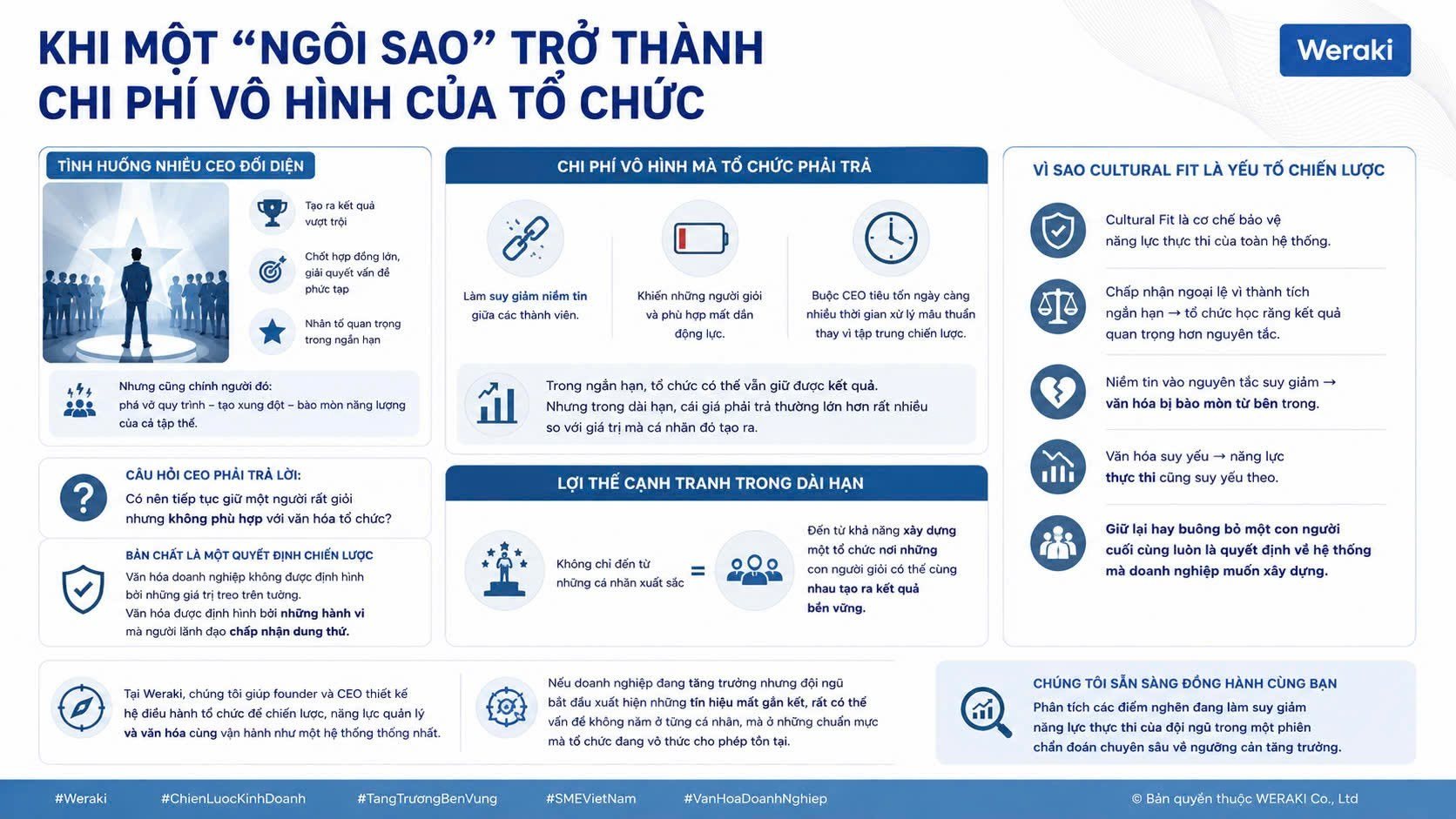
The hidden costs
A highly capable person who doesn’t fit the culture usually creates a kind of cost that is hard to see in the financial statements:
- Eroded trust
- They weaken trust between team members.
- Good-fit people lose motivation
- They make people who are both capable and a good fit gradually lose motivation.
- The CEO’s time
- They force the CEO to spend more and more time handling conflict instead of focusing on strategic decisions.
In the short term the organization may keep its results. In the long term, the price is usually far greater than the value that individual creates.
Why cultural fit is strategic
This is why many strong organizations don’t treat cultural fit as a “soft” factor. It is a mechanism that protects the execution capability of the whole system.
When leaders make exceptions for short-term performance, the organization learns that results matter more than principles. Once trust in principles weakens, culture starts to erode from within. And when culture weakens, execution weakens with it.
Hiring can start with talent. But the decision to keep or let go of a person is always, in the end, a decision about the system the business wants to build.
Long-term competitive advantage
In the long run, competitive advantage doesn’t come only from outstanding individuals. It comes from building an organization where good people can produce lasting results together.
At Weraki, we help founders and CEOs design an organizational operating system so strategy, management capability and culture work as one system. If your business is growing but the team is showing signs of disengagement, the problem may not lie with individuals, but with the norms the organization is unconsciously allowing.
In your team, which behaviors are being tolerated only because the person delivers results?
Book a consultationThank you for subscribing.