Don’t stand in the middle of the barbell unless you know the rules
A product that used to sell easily is now harder to sell than the cheapest option on the market, and harder than a high-value one too. That isn’t chance. It is the sign of a market structure that has shifted.

You invest in the best location in the area. You hire staff who know how to advise and look after customers. You make a decent product with good materials and real design work. You spend as much on marketing as international competitors.
Customers still come in. Revenue is still there. But every quarter the margin gets a little thinner, and you can’t point to anything specific that changed. No competitor undercut you, no crisis hit. It is just that, at the moment of choice, customers tend to go another way.
Have you noticed that fashion brands you loved five or seven years ago have somehow become harder to buy? They still launch collections and still advertise. But standing at the rack, you think quickly: at this price, Uniqlo is cheaper and the basics are better. For this style, the local brands on Instagram feel younger and more on-trend. If you want to spend more, there is COS. If you want true designer labels, there are Sandro and Maje.
The old brand is still there. The customers have moved to the two ends.
The middle isn’t balance
Nassim Taleb, author of The Black Swan, describes a barbell strategy, shaped like a weightlifter’s bar: heavy at both ends, thin in the middle. Most capital goes into very safe assets, a small share into high-risk bets with non-linear upside, and nothing in between. It is a risk-management strategy.
Borrowing the image, consumer markets show a clear pattern: both ends keep getting stronger while the middle thins out. The problem isn’t that the middle disappears. It is that the middle is no longer where the buying decision happens.
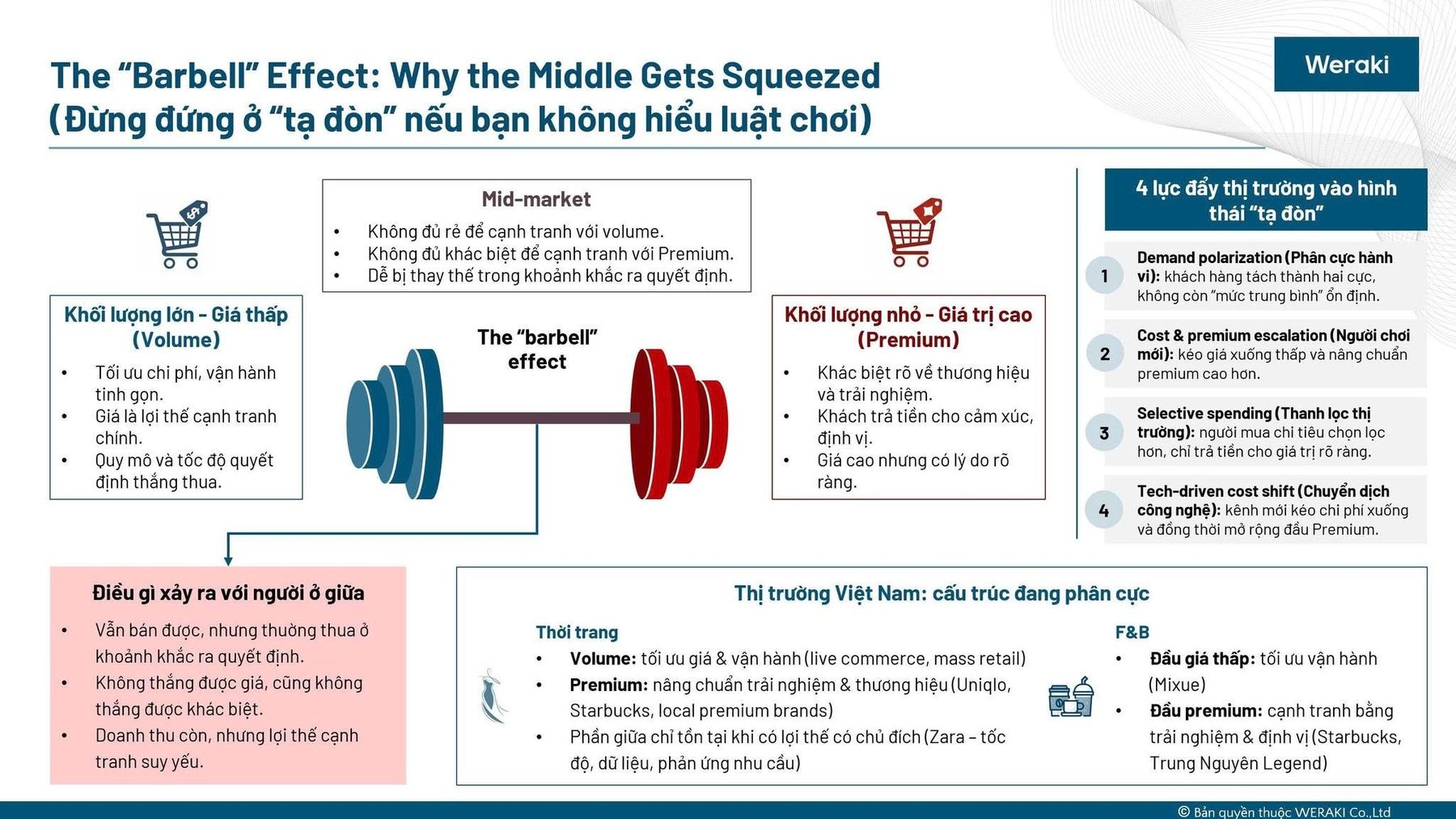
Four forces behind the barbell
- Market shake-outAfter a hot growth cycle, demand slows and spending power weakens. Buyers stop spending out of habit and become far more selective, paying only for what they truly need or what is truly worth it. Brands without clear value start to show their limits: closing stores, cutting ranges or being acquired.
- A technology shift in distributionTikTok Shop and Shopee Live push costs at the volume end very low: no stores, little inventory, factory prices, direct delivery. At the other end, Instagram and TikTok let brands build premium audiences without large store networks. Both ends get a technology boost at once, while the middle, built on traditional distribution, loses its footing.
- Polarized incomes and behaviorWealth concentrating at the top makes that group willing to spend heavily on premium and exclusive experiences. Those lower down are pushed to the cheapest option. The traditional middle thins out, or behavior splits within the same person.
- New players pulling the ends apartShein and Temu push price levels lower than ever. At the other end, local designers and brands like COS, Sandro and Maje raise the premium bar. The gap in the middle keeps widening.
When these four forces converge, the barbell is no longer just a way of looking at things. It becomes how the market operates. Vietnam’s fashion market now has all of these conditions.
What happens to those in the middle
Day to day, the shift is quiet. Products still sell, customers still visit. But at the moment of decision, every middle option has a clearer alternative at either end: not cheap enough to compete on volume, not enough experience or emotional value to compete at the premium end.
This is a brand’s most vulnerable state: still selling, but no longer giving customers a clear reason to choose it. It takes no big shock. The middle usually wears away quarter by quarter, before anyone notices what changed.
Vietnam’s market: where it shows most clearly
Fashion and food and beverage show this structure most clearly.
In fashion, the volume end belongs to live commerce on TikTok Shop and low-price sellers, where the game is price and speed. Just above, Uniqlo and H&M raise the standard of the mass segment in quality and operations. At the other end, the premium group includes local brands with their own design language, along with COS, Sandro and Maje.
Food and beverage is entering a clear shake-out in 2025–2026. At the volume end, Mixue dominates through price and operational efficiency. Just above, chains like Highlands Coffee win through coverage, location and convenience, becoming the default choice for most people. At the other end are Starbucks, Trung Nguyên Legend and boutique concepts, where experience and positioning drive the decision. The middle is under clear pressure, though some brands are actively repositioning around experience, loyalty or specific niches.
The barbell isn’t the only force shaping this period. It usually comes alongside inflation, post-pandemic behavior change and companies’ own internal problems.
Urban Vietnamese consumers also show polarization within the same person. The same well-paid 30-year-old might hunt Shein livestreams and carry a designer bag to the café; eat a 40,000-dong office lunch and book fine dining at the weekend. It is an increasingly visible urban pattern, though no industry-wide data yet measures how widespread it is. It helps explain why “evenly average” products struggle to find a stable role in everyday choices.
Who survives in the middle? The case of Zara
Forever 21 and Zara are often cited in discussions of this polarization. The popular version is that Forever 21 failed because of Shein, while Zara survived thanks to speed. In fact, Forever 21’s problems started earlier: expanding too fast, heavy debt and dependence on shopping malls just as mall traffic weakened and shopping moved online. Shein and Temu were the final push, not the only cause.
Zara controls everything from design and production to logistics and retail, cutting the cycle from idea to shelf to 2–3 weeks, against 4–6 months for traditional fast fashion. That lets it run small batches, track real sales data, then scale up or stop immediately, rather than forecasting by season.
Technology acts as an operating infrastructure. Zara puts RFID tags on every item, tracking inventory down to the unit almost in real time. Its store network is therefore not just a sales channel but a layer of data constantly feeding back into the system, so production and distribution adjust to real demand. At the same time, the in-store experience is kept alive with large flagships and frequent product changes.
Zara doesn’t stand still in the middle.
It turns the middle into a high-speed zone, an advantage by design rather than a default position.
When the barbell doesn’t apply
The barbell is clearest in industries with low switching costs and network effects too weak to hold customers. In markets with strong network effects, high regulatory barriers, or moats built on geography, relationships and ecosystems, companies’ positions tend to be more stable.
During fast growth, many “good enough” models still have room. The barbell only becomes clear when growth slows and the market enters a shake-out, when customers choose harshly rather than buying out of habit.
The cheese wasn’t taken. It moved
Facing a mid-market problem, the usual reflex is to find a culprit: a price-cutting competitor, a new platform pulling customers away, internal issues. But often the problem isn’t a competitor. It is that the market moved before you noticed.
The Coffee House has gone through almost the full life cycle of a mid-market model: rapid expansion while capital was cheap, then cutbacks and restructuring when conditions changed. The question now isn’t whether it operates well, but where to stand when the middle is no longer attractive. In fashion, brands like Canifa face similar pressure: e-commerce sellers optimizing price and speed on one side, and local and international brands moving faster on trends and positioning on the other.
When your position no longer exists in how customers decide, you are no longer competing. You are being skipped. Stay, change or leave: the decision is yours. But by the time you realize the middle has become the vulnerable zone, you have usually been there long enough.
At the moment your customers choose, what reason do they have to pick your brand over either end of the barbell?
Book a consultationThank you for subscribing.